
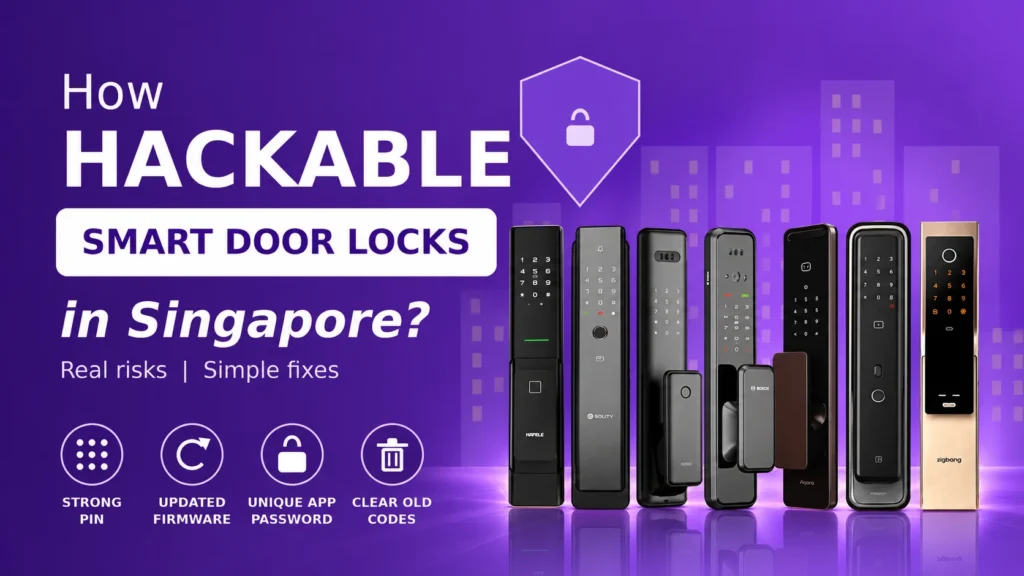
Smart door locks in Singapore can be hacked, but real cases are rare. Most attacks need a poorly built lock, weak settings, or a careless owner. A reputable lock with updated firmware and a strong PIN is hard to crack. Most break-ins still start with something simpler, like a forgotten shared code.
How hackable are smart door locks in Singapore?
Hackable in theory, low risk in practice. Researchers have broken into real products before. In June 2018, Pen Test Partners researcher Andrew Tierney showed that a fingerprint padlock called the Tapplock One could be opened with a smartphone in under two seconds. [Help Net Security]
The flaw was basic. The lock talked to its app over unencrypted Bluetooth, so the unlock details were easy to capture and reuse. The maker later pushed a firmware patch. [Silicon UK]
That was a cheap padlock, not a typical HDB digital lock. Still, it proves a point: a “smart” lock is only as safe as its engineering.
How do attackers actually get in?
Most attacks are boring, not Hollywood. These are the usual routes:
- Weak or guessable PINs. Birthdays and “123456” top the list.
- Shoulder surfing. Someone watches you type, or reads the smudges on the keypad.
- Forgotten shared codes. The old cleaner, ex-flatmate or past tenant still has access.
- Access you can’t revoke. Tierney found that sharing the Tapplock with another phone gave that user everything needed to open it later, even after permission was removed.
- Hacked accounts. If your lock app uses a reused password, your email is the weak link, not the lock.
I helped a friend check her condo unit after she moved in. The lock was fine. But the previous tenant’s code still worked, and so did three guest codes nobody had cleared for months. Check that first.
Are digital locks safe for HDB flats and condos?
Yes, if you choose a decent lock and use it properly. Many come with a mechanical key backup, which helps when the batteries die.
Fire rules matter too. Since 1 March 2024, a digital lock on a fire-rated door must be certified for fire resistance, and its rating must match or beat the door’s. [SCDF] Check the serial label near the hinges, or ask HDB or your MCST if you’re unsure.
How can you make your smart lock harder to hack?
Small habits do most of the work.
- Change the default admin code on install day.
- Use a 6-digit or longer PIN that isn’t a date or pattern.
- Delete old and temporary codes every few months. Set a calendar reminder.
- Update the firmware whenever the maker releases a patch.
- Secure your app account with a unique password and two-factor login if offered.
- Wipe the keypad now and then so smudges don’t give away your digits.
There’s a trade-off, though. Wi-Fi access is convenient but adds ways in. If you rarely need remote entry, an offline-capable lock can be the safer pick.
What should you check before buying a smart lock?
Pick a brand that publishes security updates, offers a mechanical key backup, and has reviews that mention security, not just looks.
Where can you buy smart door locks in Singapore?
That’s what we do at [Smart Lock Singapore]. We supply digital door and gate locks from Bosch, Xeno, Aqara, Igloohome, Zigbang, Hafele and Solity, for HDB, BTO, condo and landed homes.
The range covers [fire-rated locks], [gate locks], rim locks and glass-door options. Depending on the model, you can unlock by fingerprint, face, palm or phone.
We will help you match a lock to your door, and if your door is fire-rated, point you to a certified model. Customer reviews on our site mention staff explaining PIN and fingerprint setup at installation. Not sure which suits your home? [Book a free, no-obligation consultation].
So, are smart door locks in Singapore worth the risk?
For most homes, yes. Smart door locks in Singapore are safe enough when you buy from a credible brand and keep your codes tidy. The bigger risk is usually habit, not hackers.
Do one thing today: open your lock’s settings and delete every code you don’t recognise. Then [browse our digital locks] or [talk to our team] if it’s time to upgrade.
FAQ
Can someone hack my digital lock from outside the house?
Only in specific cases, such as a Bluetooth or Wi-Fi flaw in a poorly built lock. It’s unlikely with a reputable, updated brand. Most remote attacks go after your app account, so a strong, unique password matters.
Are Bluetooth smart locks less secure than PIN-only locks?
Not automatically. Bluetooth adds convenience and a little more attack surface. A well-designed lock with proper encryption is fine; a badly designed one isn’t. The maker’s security record tells you more than the connection type.
What should I do if my smart lock acts strangely?
Change all codes and your app password first. Update the firmware, then check the access log for unknown entries. If you suspect a break-in, report it to the police and contact the lock’s maker.